
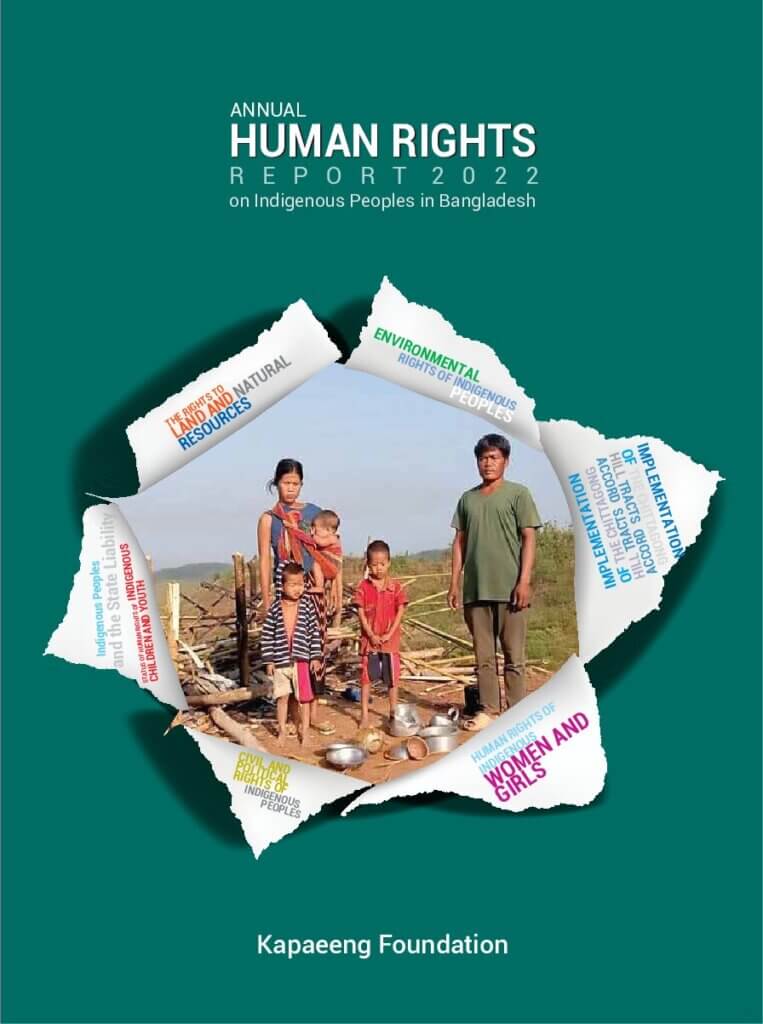
Annual Human Rights Report 2022 on Indigenous Peoples in Bangladesh
EXECUTIVE SUMMARY
BANGLADESH is a multicultural and multilingual country with more than 50 indigenous communities living in different regions. Indigenous peoples (IPs) constitute 1–2 per cent of the country’s total population and belong to distinct cultures and heritages, languages and folk literature. It has made remarkable progress in economic growth, poverty reduction, life expectancy, human development index, and many other social development indicators in the recent past. However, IPs have remained the most marginalized, excluded, and vulnerable section of society, marked by the absence of the rule of law, fundamental freedom, equality before the law, and access to justice.
Since its independence in 1971, Bangladesh has inherited, adopted, and ratified a good number of national and international laws notably, the constitution of Bangladesh, East Bengal State Acquisition and Tenancy Act, Land Reforms Ordinance, Environment Conservation Act, Environment Court Act, Forest Act, Wildlife Conservation and Security Act, Brick Manufacturing and Brick Kilns Establishment Control Act, ILO Convention on Indigenous and Tribal Populations, Convention on the Elimination of All Forms of Discrimination against Women, Convention on the Rights of the Child, International Covenant on Civil and Political Rights, International Convention on the Elimination of All Forms of Racial Discrimination, and United Nations Declaration on the Rights of Indigenous Peoples to protect and promote human rights of her citizens including the marginalized IPs. These national and international legal instruments have obliged the state to enforce human rights-related laws in the country. Does our expectation match with the social reality?
Another puzzle is why state agencies commit human rights violations when the core responsibility of the state is to save IPs from life-threatening threats. This annual report has assessed the state’s liability towards IPs by focusing on the civil and political rights of IPs, the human rights of indigenous women and girls, the rights of IPs to land and natural resources, and the current state of implementation of the CHT Accord.
Civil and Political Rights of Indigenous Peoples
Both state and non-state actors committed violations of IPs’ civil and political rights in 2022. IPs witnessed different human rights violations, including extrajudicial killing, arbitrary arrest, illegal detention, physical assault, demolition of houses, and inhuman torture. Although the state criminalized human rights activities of IPs by using fabricated cases against 71 indigenous persons in 2021, intending to create terror and strongly discourage other indigenous persons from participating in the human rights movement, no fabricated lawsuit was filed in 2022.
The overall situation of civil and political rights of IPs can be explained from several perspectives, and one of them is the geographical distribution of human rights violations. Mostly, violations of IPs’ civil and political rights happened in Chapainawabganj, Khagrachari, Bandarban, and Rangamati last year. Compared to 2021, there were improvements in several civil and political rights areas. For instance, no communal attack occurred last year; no fabricated case was filed against the indigenous person; no temple was vandalized, and no person was in forced labour. In contrast, IPs’ civil and political rights deteriorated in several other areas, such as houses looted and vandalized by security forces, indigenous persons tortured by security forces, and houses torched by Bengali settlers. Overall, IPs’ civil and political rights were worse in 2021 than in 2022 since the number of incidents was 625 in 2021and 276 in 2022.
Violence against Indigenous Women and Girls
Indigenous women and girls are victims of sexual, physical, and psychological violence, which stems from a wide range of social, cultural, and political factors that include but are not limited to political exclusion, militarization, communal aggression over ancestral lands of IPs, inferior social position, and patriarchy. A total of 21 cases of violence against indigenous women were reported from 1 January 2022 to December 2022. Of 21 such cases, 43% occurred in the plain land and 57% in the Chittagong Hill Tracts (CHT), although a sexual harassment case occurred only in the CHT. In 2022, rape cases occurred in four districts: Dinajpur, Rangpur, Rangamti, and Bandarban, while attempted rape cases happened in Sunamganj and Khagrachari. Three districts – Khulna, Bagherhat, and Chittagong witnessed gang rape cases and killing after rape cases in Chittagong and Bandarban districts. Physical attack cases occurred in Netkrona, Satkhira, Cox’s Bazar, and Bandarban, but the sexual harassment case only happened in Khagrachari. The age group of victims, whose ages ranged from 3 to 75 years. Law enforcement agencies arrested perpetrators for gang rape and physical assault cases in 2022, while nobody was arrested for other violent incidents against indigenous women and girls: rape, attempt to rape, killing after rape, abduction, and sexual harassment. In contrast, victims lodged their complaints in some cases against criminals, except for killing after rape and sexual harassment cases. Still, many indigenous victims did not take appropriate legal action against miscreants last year. It might be because of multiple factors such as poverty, lack of legal awareness, lack of access to legal aid, pressure from criminals etc.
Rights to Land and Natural Resources
While Bangladesh has adopted and ratified national and international laws to protect the rights of land and natural resources of IPs, it has failed to enforce these laws. As a result, indigenous peoples faced a good number of land-related incidents and causalities in 2022. More land-related violence occurred in the CHT than in the plain land. For instance, 37 indigenous families’ lands were grabbed in the CHT in contrast to the illegal occupation of 4 indigenous families’ land in plain land. A total of 421 acres of land were attempted to grab in the CHT, in contrast to 15 acres of land in plain land. Crops and plantations of 200 indigenous families were destroyed in the CHT compared to 5 indigenous persons in plain lands who experienced this sort of land-related incidents.
Besides, the attempted land grab in the name of establishing camps for security forces distinguishes indigenous peoples of the CHT from the plain land in 2022. However, indigenous peoples of the CHT and plain lands witnessed similar land-grabbing attacks. Notably, indigenous peoples of plain lands experienced more violence in three areas: (a) families under threat, (b) obstruction from the cultivation of their lands, and (c) the number of persons killed in land-related violence last year. In contrast, land-related violence that affected indigenous peoples as victims happened in several districts of Bangladesh, namely Thakurgaon, Dinajpur, Sherpur, Tangail, Satkhira, Sylhet, Cox’s Bazar, Khagrachari, Bandarban, and Rangamati in 2022.
The Current Implementation Status of the CHT Accord
The government of Bangladesh and the Parbattya Chattagram Jana Samhati Samiti (PCJSS) signed the historic Chittagong Hill Tracts (CHT) Accord on 2 December 1997 to end the two-decade insurgency. Twenty-five years after the signing of the Accord passed in 2022, with despair and frustration among the indigenous peoples of the CHT. Although the Silver Jubilee of the Accord was over last year, the principal aim of this Accord – the peaceful solution to the CHT conflict – has remained unfulfilled. Instead, militarization, gross human rights abuses by security forces, extrajudicial killings, ethnic tensions, communal violence, the rise of spoiler groups, land grabbing, displacement, demographic engineering, and forced assimilation have increased drastically in the post-Accord period. Consequently, indigenous peoples continue to live with fear, insecurity, and dissatisfaction with their current life, in addition to their frustration over the non-implementation of the Accord.
Surprisingly, the Awami League-led government, one of the signatory parties of the Accord, has remained in power for the last 18 years, within 25 years after signing the Accord. It is not a ‘blame game’ but an undeniable truth that the government has not taken any initiative to execute the unimplemented core issues of the Accord despite getting more than enough time for the implementation. The PCJSS claims that the government adopted no significant measure in 2022. Instead, the government has geared up state repression and ethnic cleansing policy to suppress the Jumma people’s movement to implement the CHT Accord in an undemocratic, violent and fascist manner last year, with continued arrests of the PCJSS leaders and activists, including indigenous human rights defenders. Consequently, the situation in the CHT in 2022 has remained more volatile, violent, and vulnerable.
Please see the full report:
